
 School of Cosmo
THE POVERTY TRAP (Part 1).
Why can a person work for years and still not escape a shortage of means of subsistence?
People usually speak about poverty in very simple terms. A person has money, so the person is financially secure. There is little money, so they are poor. If there is more money, the situation has improved; if there is less, it has worsened.
This picture seems perfectly obvious until you begin observing people themselves. And it can be explained if you understand how this person interacts, in every respect, with the world and with society.
Life is arranged in a considerably more complex way than even a person advanced in their development understands today.
For example, I know people who earn quite decent money and still live with a constant feeling that it is not enough. They are always occupied with financial matters, constantly calculating something, moving their funds here and there… covering one expense with another. The money seems to be there, but for some reason the feeling of sufficiency, of “there is enough”… never appears.
And yet how many people are there who objectively have far fewer financial or other means in life, but somehow retain the ability to make different plans, make different, non-financial decisions, see new possibilities and gradually change their lives.
So, it is not only a matter of the amount of money.
There is something else that determines how a person deals with what they have, how they make decisions and how they perceive their own possibilities at all. And very few understand what they have these means for, according to their life program.
And here we come to the phenomenon that I call the poverty trap.
This is not necessarily destitution. And not even necessarily a low income. There is also the concept of the poverty of human consciousness.
For a large number of people in our civilisation as a whole, the poverty trap begins at the moment when a person gradually stops perceiving their current material situation as a temporary state and begins accepting it as the limit of their own possibilities.
This happens almost imperceptibly, because nobody wakes up in the morning with the thought: “Today I will enter the poverty trap.”
On the contrary, it usually begins with perfectly reasonable things. A person really does not have enough money, and they begin to economise. Obligations really do arise, and they give up some of their plans. A crisis really does occur, and they have to concentrate on holding on to what is still left.
At the first stage, this is completely natural. A person adapts to circumstances. But if the circumstances drag on, something deeper gradually happens: adaptation becomes a way of thinking.
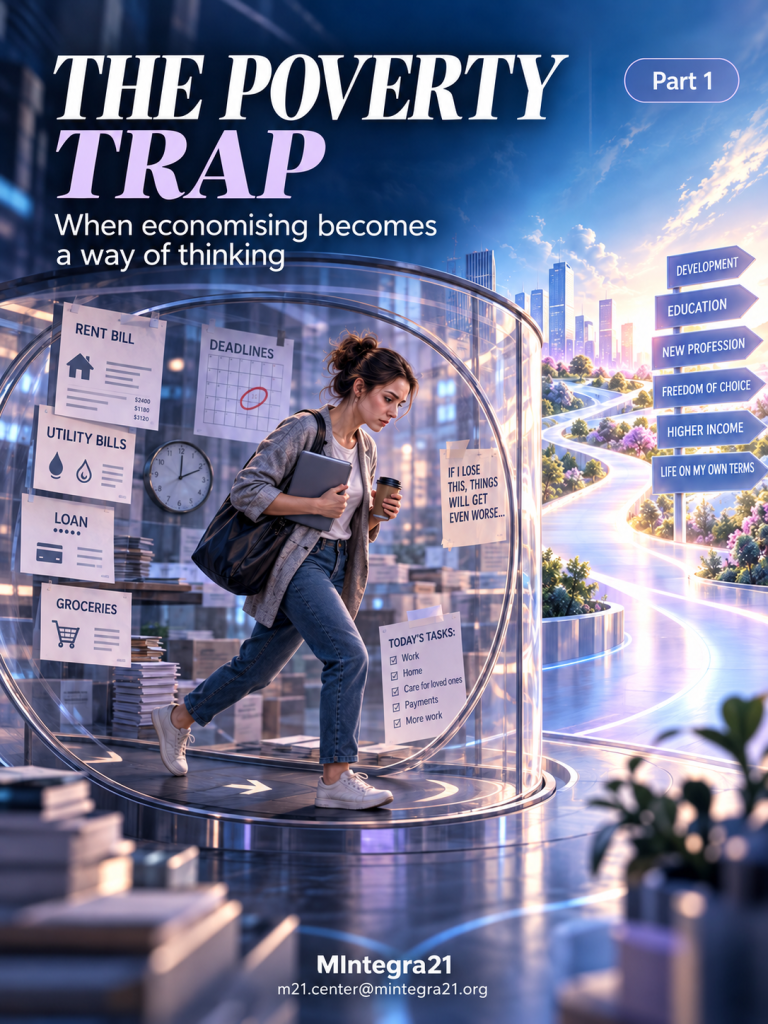
The person is no longer simply economising during a difficult period. They begin:
- To think in terms of economising all the time.
- They no longer simply give up a particular decision temporarily; they begin to believe that this decision is unavailable to them altogether.
- They no longer simply handle money cautiously; they begin to fear any step connected with uncertainty about obtaining a financial result.
And it is precisely here that a very subtle substitution takes place.
What was once a personal reaction to circumstances, laid down as a pattern in the subconscious, becomes an internal rule.
And an internal rule, reaching the level of automatism, over time begins to govern external circumstances in the society where the person interacts.
A person may live for several years with a feeling of financial instability. Then this feeling accumulates, and the words and thoughts “I cannot do it now, because this is a difficult period” are laid down in their subconscious. After some time, this phrase is shortened to something else: “I cannot afford this.”
At first glance, there is almost no difference. But it is enormous.
In the first phrase, time is present. There is a “now”. This means that the situation is understood to be capable of changing.
In the second phrase, time disappears. “I cannot afford this” already sounds like a description of their own essence and of this person’s very future life.
And if such a formula is repeated for long enough, consciousness stops looking for a way out of it. It begins organising life around it. This is where, during our diagnostics of a person’s level of consciousness, we say: “HOW YOU THINK and how you feel yourself to be, that is where your own thought activity draws you.”
And now I suggest thinking about how a person chooses work for themselves today.
A person chooses work not because it really corresponds to their possibilities and tasks, but because they are afraid of losing even a small but familiar income. They refuse learning because learning requires investment. And not only financial, but also energetic and mental investment. And to many, this seems quite beyond their strength. Because they do not understand how this will actually affect their material or psychological well-being, they do not change a system of relationships that has long since exhausted itself (if this is a partnership). They are also afraid to change work that is unpleasant to them, because the unknown seems more dangerous than familiar dissatisfaction or psychological heaviness.
And at some point it turns out that their whole life is built not around where they want to arrive, but around what they are afraid to lose.
Now this is a real trap, and a trap not only of material poverty, but of mental and energetic poverty as well.
Most people in the world continue to consider themselves free. After all, they make their own decisions. And nobody seems to force you, every day, to choose precisely this work, precisely this way of dealing with money, precisely this way of life.
However, few people understand that your freedom of choice can exist formally and be absent internally.
If every decision is restricted in advance by fear, then the person chooses only within a very small space that they have left for themselves. You yourselves have set the framework of your own boundaries and possibilities.
And here the most interesting part begins. Why does the space of choice become small?
To be continued…
AUTHOR OF THE ARTICLE:
M. BEZAN, Head of the “MIntegra21” project, Athens. October 2026.


